
A radiologist in Boston catches a lung nodule two earlier scans missed. A nurse in a small Texas clinic gets a warning hours before a patient’s vitals crash. A billing team cuts claim denials in half without hiring anyone new.
Not pitch-deck stuff. This is already happening, quietly, in hospitals that have folded healthcare AI solutions into how they run day to day.
Here’s the problem healthcare’s always had: too much data, not enough hours to look at it. Staff stretched thin, patient numbers climbing, more clinical information generated every day than any group of humans could realistically get through on their own. That’s the gap this stuff ended up filling. It’s in the emergency rooms now. In radiology. In billing offices. Even in the app a patient uses to message their doctor at 11pm because something feels off.
So what does this look like once you get past the buzzwords? That’s what I want to walk through, what these tools actually do, where they’re paying off, and what’s worth thinking about before an organization brings one in.
A quick note on scope first. This kind of software leans on machine learning, natural language processing, and computer vision to support decisions across clinical work, admin, and the general day-to-day running of a hospital. Mostly you’ll see it in diagnostic imaging, clinical decision support, remote monitoring, back-office automation, and drug discovery. Hospitals use it.
So do diagnostic labs, drug companies, insurers, and now, more and more, small physician practices too. Adoption moved fast, honestly faster than most people in the industry expected. Physician-level use in the US passed 80% in 2026. Three years before that it was under 40%. Microsoft, Google, NVIDIA, GE Healthcare, IBM and Oracle are the big names, plus a long tail of smaller health-tech startups most people haven’t heard of yet.
What’s Actually Going On Underneath
Cut through the marketing language and here’s the plain version. Software learns to spot patterns in medical data, scans, lab results, doctor’s notes, vitals, genetic markers, and uses those patterns to help with a decision someone would otherwise have to make alone. Usually under time pressure. Usually exhausted.
There isn’t one “AI” doing all this, by the way, that’s a common misconception. It’s a handful of different tools, each good at a different job. Machine learning looks for patterns in structured data, like figuring out which patients are likely to get readmitted within 30 days. Deep learning goes further than that, it handles the kind of complex pattern recognition medical imaging actually needs, where tiny differences matter a lot. Natural language processing reads through messy, unstructured notes and turns them into something searchable so a doctor’s dictated observations don’t just sit buried in a file, unread, forever. Computer vision is what lets software look at an X-ray or a pathology slide and flag something worth a second glance.
Generative AI is the newest piece of this. It drafts clinical notes now, summarizes patient histories, even helps put together treatment plans for a physician to look over and sign off on before anything happens. Predictive analytics ties a lot of this together into risk scores and early alerts.
And honestly, this needs saying plainly because it gets lost in the noise sometimes: none of this replaces a doctor’s judgment. What it does is take work that used to eat hours and shrinks it down to seconds, catching things a tired person might miss on their fifteenth chart of the day. That’s it. That’s the whole pitch, really.
Where It’s Actually Making a Difference
Medical imaging is probably where this stuff has proven itself the most, out of everywhere it’s been tried. Algorithms trained on millions of scans spot tumors, fractures, and early disease markers with a consistency that doesn’t drop off after hour ten of a shift, because it can’t get tired the way a person does. Imaging and diagnostics is still the biggest single category in the AI healthcare market, and it’s also where the FDA has cleared the most AI-enabled devices, several hundred at this point and climbing. Nobody serious is claiming this replaces radiologists, to be clear. What it adds is a second set of eyes that never gets tired, one that catches what fatigue sometimes lets slip through on a busy day.
Clinical decision support is a quieter win, but I’d argue it matters just as much. These systems pull data from a patient’s electronic health record and check it against current guidelines and similar past cases, so the doctor ends up with a ranked list of things worth thinking about (drug interactions, contraindications, likely diagnoses) before making the call. Not after. This never makes headlines the way a diagnostic breakthrough does. A missed allergy warning caught in time just doesn’t get written up. But this is where a lot of everyday harm actually gets stopped, over and over, quietly, at scale.
Remote monitoring closed a gap that used to feel unfixable. Wearables and connected devices send a steady stream of vitals into systems watching for early warning signs, often before the patient notices anything of themselves. Pair that with telemedicine and a cardiologist can track someone’s recovery from home, getting an alert the second something drifts outside a safe range. For people who live far from a hospital, this has genuinely changed what’s possible for them.
Then there’s the unglamorous part, the paperwork. A lot of the real value from AI healthcare software shows up in the back office, not the exam room. Automated coding, claims processing, prior authorization, scheduling, and AI scribes drafting clinical notes in real time so doctors aren’t stuck typing at 9pm instead of going home to their families. Clinician burnout, if you actually dig into why it happens, is largely a documentation problem at its core. That’s probably why AI scribes are one of the fastest-growing tools in enterprise healthcare AI right now, they’re going after the paperwork, not the medicine itself.
And on the research side, timelines that used to take years are shrinking fast, faster than a lot of people in pharma expected even five years ago. Machine learning screens millions of molecular compounds looking for promising drug candidates. Predictive analytics helps researchers figure out which patients are likely to respond best to a given treatment, which is really the whole foundation of precision and personalized medicine. Drug discovery’s become one of the fastest-growing corners of the entire AI healthcare market, and pharmaceutical companies are among the heaviest adopters of it.
What The Numbers Say
This isn’t a passing trend, not even close, and the numbers back that up pretty clearly if you look. The global AI healthcare market sat somewhere in the mid-$30 billion range in 2025, expected to roughly double in 2026. Several analysts are projecting north of 35% annual growth through the early 2030s. US physician adoption jumped from under 40% in 2023 to more than 80% by early 2026, a genuinely fast climb by any measure you use. AI took close to half of all healthcare venture funding in 2025, over $18 billion, even while overall healthcare VC funding actually pulled back that year. The FDA’s cleared several hundred AI-enabled medical devices at this point, radiology and cardiology leading the pack by a wide margin.
Adoption stopped waiting on proof a while back. What’s happening now is just scale, plain and simple.
The Honest Trade-Offs
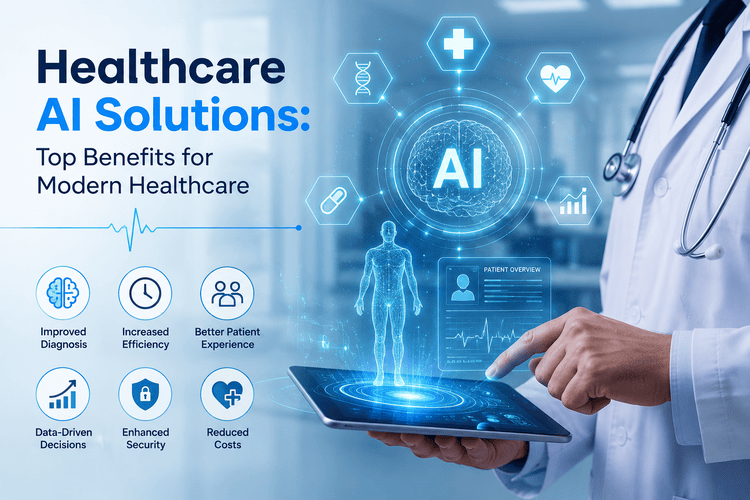
Easy to only talk about upside here, so let’s do the fuller picture. On the plus side, faster diagnosis with fewer missed errors, less paperwork and less burnout for staff, earlier detection through predictive alerts, monitoring that never gets tired, and staff freed up for actual patient care instead of admin busywork. On the other hand, these systems need large, clean datasets to train properly or they’re not very good. Connecting them to older EHR systems can be slow and genuinely expensive. There’s a real risk of bias if the training data isn’t diverse enough, something that doesn’t get talked about enough. Regulatory approval timelines vary a lot and take patience. And staff need real training before they’ll actually trust the output enough to use it day to day, not just in a demo.
Healthcare AI works best treated like a second opinion, not an answer key someone can just copy from. That distinction matters more than most vendors want to admit, and it’s usually the difference between a tool that gets quietly ignored after six months and one that actually sticks around.
How Organizations Are Actually Doing This
A few things separate rollouts that work from ones that quietly stall out, in my experience looking at this. Start small, pick one specific, painful problem, documentation time or readmission risk, instead of announcing some big company-wide “AI transformation” nobody asked for. Check the data first, before anything else. Most tools are only as good as the EHR data feeding them, and a lot of organizations skip this step, then pay for it later, sometimes badly. Bring clinicians in early too, because tools built without input from the people actually using them tend to get quietly ignored no matter how accurate they are on paper. Pick vendors with a real regulatory track record, especially for anything touching diagnosis or treatment directly. And track outcomes, not just usage numbers. Adoption looking great on a dashboard doesn’t mean much if wait times and accuracy haven’t actually moved.
Anyone weighing enterprise healthcare AI platforms should pay close attention to how well a tool connects with what’s already in place. Something that can’t talk to existing systems tends to create more work than it saves, which kind of defeats the whole point of bringing it in.
Where This Leaves Things
Healthcare AI solutions have moved past the hype stage at this point, that part’s not really debatable anymore. This technology already shapes how diagnoses get made, how patients get monitored, how hospitals run on any given Tuesday. The adoption numbers, the funding, the regulatory clearances, all of it points the same direction. This is infrastructure now, not some experiment people are still testing the waters on.
The organizations getting the most out of it aren’t chasing every new tool that comes out. They’re picking the right problem, feeding the system good data, and keeping their staff in the loop the whole way through, not just at launch. That’s usually the real difference between AI that ends up sitting on a shelf collecting dust and Healthcare AI Solutions that actually change outcomes for the people it’s meant to help.
Questions People Usually Ask
What are healthcare AI solutions, exactly?
Software using machine learning, deep learning, NLP, and computer vision to support diagnosis, treatment planning, patient monitoring, and admin tasks across hospitals and clinics.
How’s it actually working in practice?
Most systems learn from large amounts of past medical data, images, records, outcomes, and when given new patient data, compare it against what they’ve already learned to flag risks, suggest diagnoses, or just handle a task on their own.
What’s in it for the patient, really?
Faster diagnosis, earlier detection through constant monitoring, less time their doctor spends buried in paperwork, and treatment that’s actually tailored to their own health data instead of some generic protocol.
Where do hospitals usually start with this?
Small, almost always. One workflow, imaging or documentation usually, then expand once it’s proven itself works. Clean data and staff buy-in matter more than how advanced the algorithm looks on a spec sheet.
What are people still nervous about?
Data quality and bias mostly, connecting to legacy systems, slow regulatory timelines, and getting staff comfortable enough to actually trust and use the tools day to day instead of ignoring them.
Is it even safe, is it regulated properly?
Increasingly, yes. Hundreds of AI-enabled devices have gone through FDA clearance already, and rules built specifically around healthcare AI keep expanding as adoption grows.