
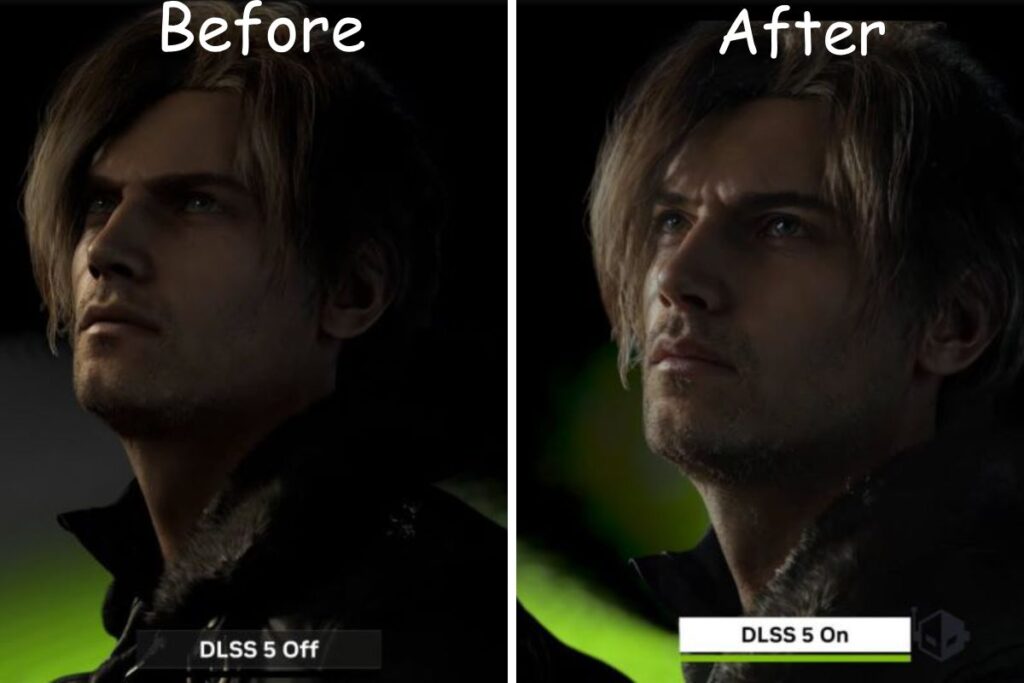
NVIDIA unveiled DLSS 5 at GTC 2026, a next-gen AI-driven upscaling that “infuses pixels with photoreal lighting and materials”. It promises cinema-quality visuals at real-time speeds, targeting a Fall 2026 launch. Officially, NVIDIA has not yet published exact GPU requirements, stating only that “minimum GPU specifications are pending” and will be announced closer to release. However, all signs point to RTX 50 (Blackwell) GPUs as the primary platform.
Blackwell’s 5th-generation Tensor cores and 4th-generation RT cores were designed for DLSS 5’s neural-rendering models. In this analysis, we review NVIDIA’s statements, technical requirements, and credible coverage to assess whether DLSS 5 will run on RTX 50 cards (and to what extent). We compare RTX 40 vs 50 hardware (table below) and outline possible scenarios: full support (very likely for 50-series), partial support (e.g. limited on lower-end or older cards), or no support. Sources are primarily NVIDIA’s own press and technical briefs, plus expert reporting.
In conclusion, we find strong evidence for full DLSS 5 support on the RTX 50 series, though specifics (e.g. performance, memory) remain uncertain. Follow-up: watch for NVIDIA’s detailed spec announcement closer to Fall 2026.
NVIDIA’s DLSS 5 Announcement and Timeline
In March 2026 NVIDIA officially announced DLSS 5, calling it “the single most significant advancement in graphics since ray tracing”. It’s described as a real-time neural rendering model that uses game-provided color and motion vectors to re-light scenes with “photoreal lighting and materials”. NVIDIA confirms DLSS 5 is backed by major game studios (e.g. Ubisoft, Bethesda, Capcom) and targets a Fall 2026 release. Early demos (e.g. Starfield) ran on dual RTX 5090s (one for game, one for AI), but NVIDIA says the shipping version will run on a single GPU.
Importantly, NVIDIA has not yet listed specific GPU models. A GeForce forum Q&A bluntly says: “Minimum GPU specifications are pending model optimizations and will be provided closer to release.”. In other words, NVIDIA is keeping its cards close.
The timeline above shows key milestones. DLSS 5’s GTC 2026 unveiling and the planned release timeframe are documented by NVIDIA. The RTX 50 (Blackwell) GPUs were themselves announced in early 2025. DLSS 4.5 (an interim update) was introduced in early 2026 to all RTX GPUs, but DLSS 5 is a fundamentally new algorithm built for generative lighting.
DLSS 5 Technical Requirements (Tensor/AI Hardware)
DLSS 5’s real-time neural rendering is extremely compute-intensive. Unlike earlier DLSS versions (which mostly upscaled images), DLSS 5 generates new pixel details. It relies on a trained AI model that “infuses the scene with photoreal lighting and materials” anchored to the game’s geometry. Technically, this requires massive tensor-compute.
According to NVIDIA, Blackwell’s 5th-gen Tensor Cores offer new low-precision modes (FP4 with micro-scaling) and 1.5× the AI compute of prior architectures. By contrast, Ada (RTX 40) has 4th-gen Tensor Cores with FP8 support.
Videocardz testing of DLSS 4.5 (an advanced model already) shows that RTX 40/50 cards (with FP8) suffer only ~2–3% speed hit, whereas older RTX 20/30 cards see >20% slowdown. This is largely because Ada/Blackwell support 8-bit tensor math. DLSS 5’s model is reportedly even heavier: official docs note it’s akin to GPT-sized networks running at 60+fps in games.
Early GTC demos required 32GB of VRAM (two 5090s) to run a single 4K scene, hinting at very high memory use. In short, DLSS 5 needs the latest tensor hardware and lots of memory.
The table below summarizes relevant hardware differences:
| Feature | RTX 40 Series (Ada Lovelace) | RTX 50 Series (Blackwell) |
|---|---|---|
| Architecture (Launch) | Ada Lovelace (2022) | Blackwell (2024-25) |
| Tensor Cores | 4th Gen (support FP8 precision) | 5th Gen (support FP4 & FP8 precision) |
| Ray-Tracing Cores | 3rd Gen RT cores | 4th Gen RT cores |
| Optical-Flow Accelerator | Yes (dedicated OFA for DLSS3) | Not used (DLSS5 uses in-game motion vectors) |
| DLSS Support | DLSS 2–4 fully; DLSS 4.5 (MFG) via driver | DLSS 2–4 fully; DLSS 4.5 & new modes; DLSS 5 planned (Blackwell-designed) |
| Multi-Frame Generation | No native support (Ada GPUs lack MFG) | Yes – enabled via driver override |
| Peak VRAM | Up to 24 GB GDDR6X | Up to 32 GB GDDR7 (on flagship) |
| Neural Rendering (AI) | N/A (no neural shaders) | Yes (new “neural shaders” technology) |
Key takeaways: RTX 50 GPUs have the fifth-gen Tensor cores and new neural-rendering blocks needed for DLSS 5, whereas RTX 40 (Ada) lacks some of these capabilities. RTX 40 does have FP8 on Tensor cores and thus can run heavy AI models better than older cards, but it does not include Blackwell’s full feature set (e.g. neural shading).
The driver also gives RTX 50 series new features: e.g. NVIDIA’s January 2026 drivers added a DLSS override for Multi-Frame Generation that only works on 50-series cards. In practice, this means RTX 50s already got special DLSS 4.5 modes that RTX 40s did not. By extension, DLSS 5 is expected to fully leverage Blackwell’s hardware.
Figure: The same frame without ray tracing (RTX Off) looks flat and less detailed. DLSS 5’s neural rendering is intended to make real-time graphics as rich as offline-rendered scenes.
Compatibility Scenarios: Full, Partial, or None?
NVIDIA’s official FAQ simply defers: “Minimum GPU specifications are pending… closer to release”. In the absence of a crisp statement, we consider possible scenarios:
- Full Support on RTX 50 Series: This is the most plausible scenario. Blackwell cards have all required hardware (Tensor and RT cores) to run DLSS 5, and NVIDIA’s marketing indicates DLSS 5 is a Blackwell-era feature. In fact, TechPortal notes DLSS 5 “is designed to fully leverage the capabilities of Blackwell architecture, including the RTX 50-series”. Given that NVIDIA demoed DLSS 5 on two RTX 5090s and says it will run on one of those at launch, we expect RTX 5090/5080 etc. will support DLSS 5 in full. Even lower-end 50-series cards have the same new cores, so in principle they can run it too, though likely at reduced performance if VRAM or tensor throughput is lower.
- Partial Support (50-series Subset or Features Only): A middle scenario is that DLSS 5 will work on RTX 50 cards but with some caveats. For example, it might require a high-end 50-series card (like 5090) or reduced fidelity settings on lower models. The VRAM demands hinted by early demos suggest cards with ≤16 GB might struggle at max settings. NVIDIA may ship DLSS 5 models tuned for 5090-class GPUs, with 5080/5070 supporting a lighter version (e.g. lower lighting detail). In previous DLSS updates, NVIDIA sometimes limited advanced modes to top-tier GPUs; a similar “downscaled mode” for older 50-series parts is conceivable. That would mean “partial support” in practice – e.g. DLSS 5 could run but some intensity controls or ultra-settings might be disabled on smaller cards.
- No Support on RTX 50: This is highly unlikely. Since DLSS 5 was revealed after the 50-series launch and was clearly built on Blackwell’s architecture, it would not make sense to exclude the very hardware it was demonstrated on. The only hypothetical “no support” would be if NVIDIA held DLSS 5 exclusively for a next generation beyond Blackwell, but we see no indication of that. (Indeed, NVIDIA’s statement says it will run on a single GPU at launch, implying current high-end hardware suffices.) We can safely rule out no support on 50-series.
By contrast, RTX 40-series (Ada) likely cannot run full DLSS 5. Their hardware lacks Blackwell’s specialized tensor and neural blocks. Even if a trimmed-down DLSS 5 mode were engineered for Ada, it would suffer major slowdowns – much like forcing DLSS 4.5 models on RTX 30-series caused huge framerate hits. Early reports suggest that DLSS 5 “runs on RTX GPUs with Blackwell architecture”, implying Ada may not be officially supported. In summary:
- Full support on RTX 50 series – Very likely. NVIDIA built DLSS 5 for Blackwell.
- Partial support on 50 series – Possible (e.g. only on higher-end 50 cards or reduced settings) if VRAM/performance limits appear.
- No support on 50 series – Unlikely. No statements hint at excluding 50-series.
Conclusion and Outlook
Based on all available evidence, DLSS 5 is almost certain to run on NVIDIA’s RTX 50-series GPUs. The technology was announced in tandem with the Blackwell architecture and was demoed on RTX 5090 hardware. NVIDIA’s marketing and Q&A imply Blackwell is the target platform: DLSS 5 “leverages” Blackwell’s new AI cores, and NVIDIA has yet to release any cross-generation plan.
Practically, gamers with RTX 50 cards should expect DLSS 5 support on day one of its game releases. Lower-spec 50-series models might see some features dialed back for performance, but full DLSS 5 upscaling (with all lighting enhancements) will be a flagship feature of the 50-series lineup.
Uncertainties remain: NVIDIA has been tight-lipped on details. We don’t know the exact minimum GPU class, performance cost, or VRAM requirements. It’s possible that only the most powerful 50-series cards will run the most demanding DLSS 5 modes smoothly. We also must watch for driver updates. NVIDIA’s recent GeForce app updates added new DLSS modes specifically for 50-series (e.g. 6× Multi Frame Gen). Similarly, initial DLSS 5 rollout may come as a special SDK/driver update for Blackwell GPUs.
Recommended follow-ups: Keep an eye on NVIDIA’s official communications (especially around upcoming GTC or Gamescom) for a hardware spec sheet. Watch major tech outlets (AnandTech, Tom’s Hardware, The Verge) for hands-on tests once DLSS 5 reaches beta. In particular, NVIDIA’s own DLSS SDK release notes and GTC slides (post-event) might clarify hardware compatibility. In the meantime, prepare RTX 50 hardware for what NVIDIA calls a “GPT moment for graphics” – it’s coming soon, and it’s built with Blackwell in mind.
Sources: NVIDIA press releases and blog posts; NVIDIA developer forum Q&A; tech reporting from TechPortal and Videocardz; GeForce hardware pages; and related interviews and driver notes cited above.