

Apple has quietly rolled out the MacBook Neo, a new entry-level 13-inch laptop designed to deliver the “magic of the Mac” at a breakthrough price. Officially unveiled March 4, 2026, the Neo packs the same A18 Pro system-on-chip found in last year’s iPhone 16 Pro, along with 8 GB of unified RAM and either 256 GB or 512 GB of flash storage. With a starting price of $599 (only $499 with education discount), it’s now Apple’s cheapest notebook ever – about $500 less than the entry MacBook Air. Apple claims it delivers up to 16 hours of video playback on a charge, making it an all-day laptop for students and budget-minded users.
Colorful, Compact Design with No Notch
Apple’s new MacBook Neo comes in four cheerful colors – blush, indigo, silver, and a fresh citrus green – and features a slim, rounded aluminum body that weighs just 2.7 pounds. Unlike the high-end MacBook Air and Pro, the Neo’s 13-inch Liquid Retina display has thicker bezels with no notch, giving it an iPad-like aesthetic. The 2408 × 1506 screen reaches 500 nits of brightness and supports 1 billion colors, which Apple says is brighter and sharper than most laptops at this price. Apple even color-matches the keyboard and wallpaper to the chassis for a fun, cohesive look – “making MacBook Neo the most colorful MacBook yet”.
Under the Hood: iPhone Chip, 8 GB RAM, and More
Inside, the Neo is powered by the A18 Pro chip – the same 6‑core CPU (2 performance + 4 efficiency) and 5‑core GPU used in the iPhone 16 Pro. With 8 GB of fixed unified memory, it can breeze through everyday tasks, web browsing, document editing and even on-device AI like photo effects. Apple touts that the Neo is “up to 50 percent faster for everyday tasks” than a comparable Intel-based Windows laptop. (Tech analysts note it’s actually a slightly binned version of the A18 Pro – one fewer GPU core – likely to hit Apple’s price target.) The entry model ships with a 256 GB SSD; an upgraded 512 GB model (with Touch ID on the power button) costs $699.
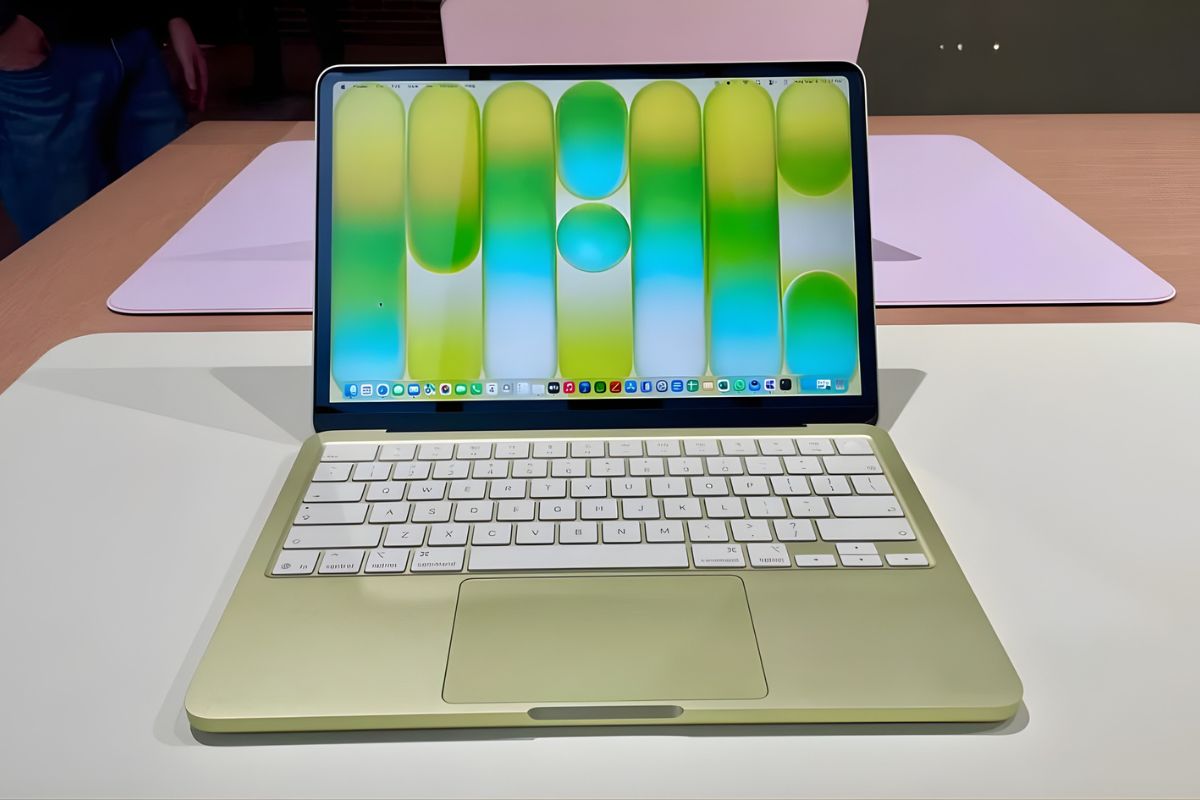
The Neo has a 1080p FaceTime HD camera, dual microphones, and side-firing stereo speakers that support Spatial Audio. Wireless is modern: Wi‑Fi 6E and Bluetooth 6 are onboard. On the flip side, Apple cut costs by including only two USB-C ports (one USB 3.0, one USB 2.0) and a headphone jack. MagSafe charging and Thunderbolt are not supported, and one USB-C port can only drive one external 4K display (through USB3). This means the Neo is a very basic MacBook – lean on features, but sufficient for students and new Mac users.
Battery Life, Weight, and Build
Thanks to the efficiency of Apple silicon, the MacBook Neo boasts all-day battery life. Apple rates it for “up to 16 hours of video streaming” on a single charge – far longer than any previous sub-$600 MacBook. At only 0.50 inches thick and weighing 2.7 lb, it’s extremely portable. The build is fanless and silent, so it’s comfortable in the classroom or on your lap. Overall, Apple’s hardware PR touts a durable aluminum chassis that’s “built to last”.
Price, Release Date, and Education Discounts
The MacBook Neo launched with pre-orders on March 4, 2026 and will hit stores on March 11. At $599, it’s $500 cheaper than the existing MacBook Air. Apple is clearly targeting education: students and teachers can grab each Neo for just $499. In fact, Apple bills this as its “most affordable laptop ever”. In comparison, the new 13-inch MacBook Air with the M5 chip now starts at $1,099 ($999 educational), while the high-end 14-inch MacBook Pro (M5 Pro) starts at $1,699.
MacBook Air (M5) and Pro (M5 Pro) – The Next Rungs
Apple’s March 2026 event also refreshed the higher-end MacBooks. The MacBook Air (13‑inch) now ships with the M5 chip, a beefier 10‑core CPU/8‑core GPU configuration, 16GB memory base, and 512GB SSD base. It offers a slightly larger 13.6-inch Liquid Retina display (500 nits, 1B colors) and up to 18 hours battery life. It still has two Thunderbolt 4 ports and MagSafe charging, and comes in new Sky Blue, Midnight, Starlight and Silver finishes. (The 13″ M5 Air starts at $1,099.)
For pros, the 14-inch MacBook Pro now features the M5 Pro chip. The base 14″ model packs a 15‑core CPU and 16‑core GPU (with 24GB RAM and 1TB SSD at $1,699), up to 18 CPU cores / 20 GPU cores in higher configs. It has a Mini-LED Liquid Retina XDR display (up to 1600 nits HDR), three Thunderbolt 5 ports, HDMI, SDXC slot and MagSafe 3 – ports the Neo lacks. Battery life can reach an astonishing 24 hours. For scale, below is the new 14″ MacBook Pro (Space Black) with its giant display and more pro features:
Image: Apple’s new 14‑inch MacBook Pro (M5 Pro) with Thunderbolt 5, HDMI, and MagSafe – up to 24 hours of battery life.
Comparing Neo vs. Air vs. Pro
| Feature | MacBook Neo (13″) | MacBook Air (13.6″, M5) | MacBook Pro (14″, M5 Pro) |
|---|---|---|---|
| Launch Price | $599 (256GB); $699 (512GB w/ Touch ID) | $1,099 (16GB / 512GB) | $1,699 (24GB / 1TB) |
| Chip / CPU | Apple A18 Pro (6-core CPU) | Apple M5 (10-core CPU) | Apple M5 Pro (15-core base) |
| GPU Cores | 5-core GPU | 8-core GPU | 16-core GPU |
| Memory (RAM) | 8GB (fixed) | 16GB (base) | 24GB (base) |
| Storage (SSD) | 256GB / 512GB | 512GB (base) | 1TB (base); 2TB on M5 Max |
| Display | 13″ Liquid Retina (2408×1506, 500 nits) | 13.6″ Liquid Retina (500 nits) | 14.2″ Liquid Retina XDR (1600 nits peak, nano-texture optional) |
| Ports | 2× USB-C (USB 3 + USB 2), 3.5mm jack | 2× Thunderbolt 4, MagSafe 3, 3.5mm jack | 3× Thunderbolt 5, HDMI, SDXC, MagSafe 3, 3.5mm jack |
| Battery Life | Up to 16h video playback | Up to 18h video playback | Up to 24h video playback |
| Weight | 2.7 lbs | 2.7 lbs | ~3.5 lbs |
(Data from Apple’s March 2026 announcements and press coverage.)
Who is the Neo For? Apple’s Budget-Mac Strategy
In short, MacBook Neo isn’t meant to replace your MacBook Air – it’s meant to grow the Mac market. As The Verge notes, Apple is clearly targeting first-time Mac buyers, students and even Chromebook users with this sub-$600 machine. The Neo delivers a lot of premium feel (retina screen, aluminum case, all-day battery) at a Windows‐laptop price point. For families or schools that need a MacBook but can’t spend $1,000+, the Neo is a compelling choice.
It also blurs the line between iPhone and Mac: Apple now sells a laptop powered by an iPhone processor (albeit binned for efficiency). That hints at an interesting new direction – can a smartphone chip fully replace an M‑series chip for basic computing? Early reviews and hands-on reports suggest the answer is “yes” for day-to-day use, as long as you don’t need heavy graphics or Thunderbolt speeds.
At press time, no official MacBook Neo “2” has been announced, but one can imagine future refreshes: perhaps a Neo with the next A-series chip (iPhone 17’s A19 Pro), or even an 8 GB→16 GB RAM bump. For now, the Neo stands as Apple’s colorful, wallet-friendly “gateway” MacBook. It offers a taste of Mac power and polish at a breakthrough price – as John Ternus put it, “there is simply no other laptop like it”.
Sources: Official Apple Newsroom press releases and product pages; tech reporting from Macworld and The Verge.